
Conspicuous Links Aren’t Enough: Critical Lessons from Sanchez v. Maggy London on Enforceable Online Terms

The U.S. District Court for the Southern District of California recently delivered a stark reminder to online businesses: simply having a conspicuous link to your terms and conditions doesn’t guarantee enforceability. In Sanchez v. Maggy London International Ltd., the court denied Maggy London’s motion to compel arbitration, finding that while their hyperlink to the terms of service was reasonably conspicuous, the company failed to clearly communicate that clicking “Pay Now” constituted agreement to those terms.
This November 2025 decision reinforces a critical principle: designing enforceable terms and conditions requires more than aesthetic prominence; it demands unambiguous manifestation of user assent.
Case Background
Monica Sanchez purchased a dress from Maggy London’s e-commerce website on May 13, 2025, for $138.00. The website displayed this price alongside a strikethrough price of $168.00, which Sanchez alleged was not the “prevailing market price” in the preceding 90 days. She filed a putative class action in California Superior Court alleging violations of California’s false advertising and unfair competition laws related to phantom discount pricing practices, a favorite for “opportunistic litigation.”
Maggy London removed the case to federal court and moved to compel individual arbitration based on an arbitration clause contained in the website’s terms of service. The company argued that Plaintiff had both reasonable notice of the terms and unambiguously manifested assent by clicking the “Pay Now” button during checkout.
The Court’s Analysis: Two-Part Test for Online Agreement Formation
Under California law, courts apply a two-pronged test to determine whether an online agreement is enforceable. Unless the website operator can show actual knowledge of the agreement, an enforceable contract requires:
- Reasonably conspicuous notice of the terms to which the consumer will be bound; and
- Unambiguous manifestation of assent through some affirmative action, such as clicking a button or checking a box.
Part One: Conspicuous Notice (Maggy London Succeeded)
The court agreed that Maggy London’s checkout page provided reasonably conspicuous notice. The evidence showed:
- A hyperlinked “Terms of service” text in light blue, underlined font
- Placement directly below the “Pay Now” button
- Font that was clearly “legible to the naked eye”
- A relatively uncluttered checkout page design
- Immediate proximity to the action button
Judge Marilyn Huff concluded that “a reasonably prudent Internet user would have seen it,” citing similar findings in cases like Patrick v. Running Warehouse, LLC and Dohrmann v. Intuit, Inc.
Part Two: Manifestation of Assent (Where Maggy London Failed)
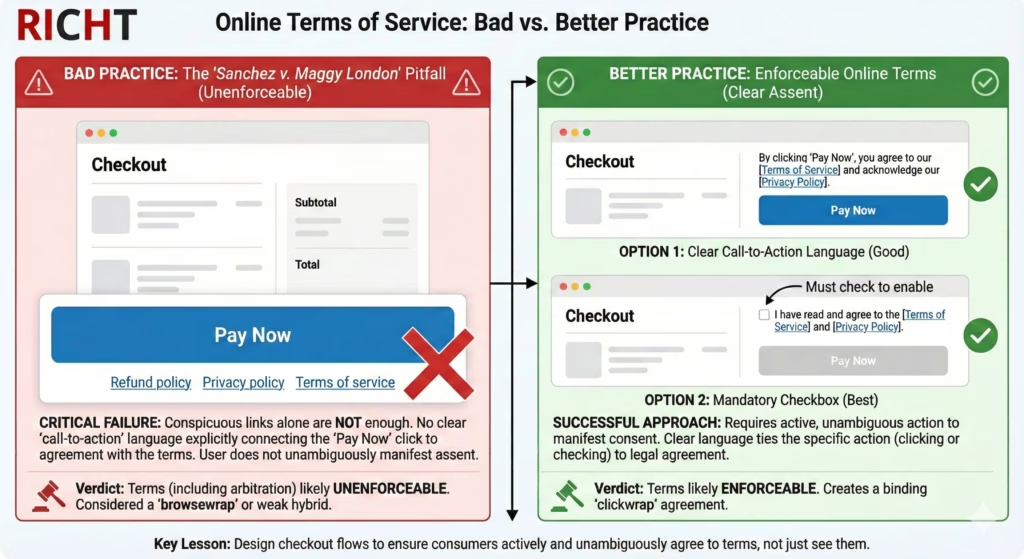
Despite winning on the first prong, Maggy London’s approach failed the critical second requirement. The court held that simply having a conspicuous hyperlink was insufficient to bind users to the terms.
Following Ninth Circuit precedent, particularly Berman v. Freedom Financial Network and Nguyen v. Barnes & Noble Inc., the court emphasized that “a user’s click of a button can be construed as an unambiguous manifestation of assent only if the user is explicitly advised that the act of clicking will constitute assent to the terms and conditions of an agreement.”
The court found that Maggy London’s checkout process lacked any advisal language informing users that clicking “Pay Now” would legally bind them to the terms of service. The judge noted: “While Plaintiff acted in placing the order, that action cannot reasonably be construed to have manifested assent to the terms of service located below.”
The Missing Element: Explicit Advisal Language
The decision makes clear what was absent from Maggy London’s checkout flow. The court suggested language such as:
“By clicking pay now, you confirm you have read, understood, and agree to the Terms”
This explicit notification of the legal significance of the user’s action is what the Ninth Circuit has consistently required in cases like:
- Patrick v. Running Warehouse (9th Cir. 2024) – finding inquiry notice because of explicit advisal
- Keebaugh v. Warner Bros. Entertainment Inc. (9th Cir. 2024) – same
- Oberstein v. Live Nation Entertainment, Inc. (9th Cir. 2023) – same
Conversely, the court cited multiple precedents where conspicuous links without explicit advisal failed:
- Nguyen v. Barnes & Noble (9th Cir. 2014) – “even close proximity of the hyperlink to relevant buttons users must click on—without more—is insufficient”
- Berman v. Freedom Financial Network (9th Cir. 2022) – explicit textual notice is “critical to enforceability”
- Chabolla v. ClassPass Inc. (9th Cir. 2025) – same
- Wilson v. Huuuge, Inc. (9th Cir. 2019) – same
How This Differs from Recent Cases Upholding Online Terms
The Sanchez decision creates an interesting contrast with other recent cases we’ve analyzed where terms were found enforceable:
Dhruva v. CuriosityStream, Inc. (4th Cir. 2025): The Fourth Circuit upheld CuriosityStream’s terms despite similar concerns raised in a dissent. However, even that decision emphasized the need for websites to make clear that users are agreeing to terms; not just that they’ve read them. The proper phrasing: “By subscribing, you agree that you have read and you agree to our Terms of Use” (emphasis added).
Wu v. Uber Technologies (N.Y. 2024): Uber’s arbitration clause was enforced because the company sent email notifications, displayed in-app pop-ups with hyperlinked terms, and required a checkbox, demonstrating active consent beyond mere link proximity.
The common thread: explicit language connecting the user’s action to their agreement is essential.
Clickwrap vs. Browsewrap: Why This Matters
This case underscores why courts consistently favor clickwrap agreements over browsewrap approaches:
| Feature | Clickwrap (Enforceable) | Browsewrap (Often Fails) |
|---|---|---|
| User Action | Requires explicit agreement (checkbox, “I Agree” button) | Assumes agreement through website use |
| Notice | Terms presented during critical actions | Terms hidden in footers or obscure links |
| Language | “By clicking ‘Accept,’ you agree to…” | “By using this site, you accept our terms” |
| Court Acceptance | High (clear evidence of assent) | Low (often unenforceable due to ambiguity) |
Maggy London’s approach fell into a dangerous middle ground: more conspicuous than pure browsewrap, but lacking the explicit consent mechanism that defines clickwrap.
The Professional Plaintiff Factor
The court acknowledged in a footnote that Monica Sanchez is a “serial litigant” with a history of bringing similar false advertising and terms of service challenges against numerous companies, including Delta Galil USA, Marriott International, Cars.com, Brinker International, The Travelers Indemnity Co., Organifi LLC, National Instruments Corp., and True Legacy Human Resources.
Despite this background, the court found no basis to assume actual knowledge of the terms. The judge noted that while “a reasonable person in a similar position to that of Plaintiff would likely have actual notice,” Plaintiff’s role as a “tester” does not alone establish actual notice.
This is a critical reminder: even when facing professional plaintiffs who likely understand online terms better than average consumers, companies cannot rely on assumptions. The law requires demonstrable proof of inquiry notice, which can only be established through proper advisal language.
Practical Implications for E-Commerce and SaaS Businesses
For E-Commerce Websites
This decision has immediate implications for online retailers using checkout flows similar to Maggy London’s. If your checkout page shows terms as hyperlinks near a purchase button without explicit consent language, your arbitration clauses, limitation of liability provisions, and other critical contract terms may be unenforceable, even in California and the Ninth Circuit.
For SaaS Platforms and App-Based Services
The principles apply equally to subscription services, mobile apps, and web-based platforms. Account creation flows, subscription checkouts, and service activation processes all need to clearly link the user’s action to their agreement to the terms.
Related Compliance Considerations
The same principles apply to other essential online agreements:
- Privacy Policies: Users should explicitly acknowledge reviewing privacy practices, especially given CCPA, CPRA, and other state privacy law requirements
- Cookie Consent: While separate from terms of service, consent banners should similarly require affirmative action
- Marketing Communications: TCPA compliance and other consent-based marketing regulations benefit from the same clarity
- Online Reviews and User-Generated Content: Terms governing user submissions need enforceable acceptance
As we discussed in our comprehensive guide to Privacy Policies, Terms and Beyond, these agreements work together to form your digital compliance framework, and each needs proper user consent.
Six Essential Steps to Fix Your Online Terms
Based on this decision and the broader body of case law on enforceable online agreements, businesses should implement these practices:
1. Use Explicit, Action-Oriented Language
Do This:
- “By clicking ‘Complete Purchase,’ I acknowledge that I have read and agree to the Terms of Service and Privacy Policy”
- “I have read and agree to the [Terms & Conditions] and [Privacy Policy]” (with checkbox)
Don’t Do This:
- Just showing hyperlinks near an action button
- “Terms of Service” | “Privacy Policy” | “Refund Policy” without connecting language
- Assuming proximity equals agreement
2. Require Affirmative Action
Implement unchecked checkboxes that users must actively select before proceeding to create an account, make a purchase, or other key actions. Pre-checked boxes may fail to demonstrate genuine consent, and no checkbox, as in Maggy London’s case, provides evidence of agreement.
3. Make Hyperlinks Prominent and Accessible
While conspicuousness alone isn’t sufficient, it remains necessary:
- Use contrasting colors (dark blue, not light gray)
- Underline hyperlinks
- Ensure minimum 12pt font size
- Test on mobile devices where users actually transact
- Place links where users naturally look before taking action
4. Time the Request for Consent Appropriately
Present terms at critical moments when users are making meaningful decisions:
- Account registration (not just first login)
- Initial subscription or purchase
- Service upgrades or changes
- When terms are materially updated
For guidance on updating terms and notifying users, proper notice procedures are critical to maintaining enforceability.
5. Eliminate Distractions During Consent
The court favorably noted that Maggy London’s checkout page was “relatively uncluttered.” Follow this principle:
- Present terms on a clean screen
- Avoid competing calls-to-action
- Remove advertisements from checkout/signup flows
- Don’t bury consent in lengthy forms
6. Document Everything
Maintain detailed records of:
- Timestamps when users accepted terms
- IP addresses and device information
- The exact version of terms presented
- Screenshots of the acceptance interface
- Changes to terms over time
This documentation proves invaluable when defending against challenges to agreement validity—particularly against professional plaintiffs who may claim they never saw or agreed to terms.
The Browsewrap Death Knell
This decision continues the judicial trend away from accepting browsewrap agreements. The Ninth Circuit has made abundantly clear through cases like Nguyen, Berman, and now Sanchez that:
“A link to the terms of service, absent more, is not enough.”
Even when companies invest in conspicuous design, clear typography, and optimal placement, as Maggy London did, courts will not infer assent from passive user behavior. The law demands affirmative, informed consent.
For businesses still relying on browsewrap approaches (footer links to terms with “By using this website” language), the message is clear: convert to clickwrap immediately. The risk of having your most important contractual protections, such as arbitration clauses, liability limitations, and intellectual property terms, deemed unenforceable is simply too high.
Key Takeaways for Legal and Business Teams
- Conspicuousness is Necessary But Not Sufficient: You can have the most beautifully designed, prominently placed hyperlink to your terms, and still fail to create an enforceable agreement without explicit advisal language.
- Explicit Language Bridges the Gap: The missing element in most failed online agreements is simple: explicitly telling users that their action constitutes agreement. “By clicking [name of button or action], you agree to the [Terms]” is not merely best practice—it’s legally required in the Ninth Circuit and increasingly elsewhere.
- Professional Plaintiffs Won’t Save You: Even when facing sophisticated serial litigants who almost certainly understand online terms better than average users, you cannot rely on actual knowledge. The law requires demonstrable notice through proper design and language.
- The Ninth Circuit Standard is Strict: Businesses operating nationally should design to meet Ninth Circuit standards, which are among the most stringent. What passes in the Fourth Circuit may not survive in California, Oregon, Washington, or other Ninth Circuit jurisdictions.
- Arbitration Clauses Require Extra Scrutiny: When your terms include provisions to compel arbitration and waive class actions—as most do—courts apply heightened scrutiny to the consent process. An unenforceable agreement means facing class actions in court rather than individual arbitrations.
- Mobile Optimization Matters: With most e-commerce occurring on mobile devices, your consent flow must work seamlessly on small screens. What looks conspicuous on desktop may be invisible or confusing on mobile.
- Regular Legal Review is Essential: Online agreements require periodic review not just for content updates, but to ensure the acceptance mechanism meets evolving legal standards.
What Businesses Should Do Now
If you operate an e-commerce website, subscription service, or any platform requiring user agreement to terms:
- Audit Your Current Consent Flow: Take screenshots of every step where users might be deemed to accept terms. Would a court find “unambiguous manifestation of assent”?
- Review Your Language: Search for phrases like “By clicking” or “I agree to” near your action buttons. If they don’t exist, you have a problem.
- Implement Checkboxes Where Appropriate: For account creation, subscriptions, and purchases, unchecked checkboxes with explicit consent language provide the strongest evidence of agreement.
- Test Across Devices: Your checkout or signup flow might be perfect on desktop, but fail on mobile. Test everything.
- Update Documentation: Ensure you’re logging consent timestamps, the version of terms accepted, and user identifiers for future reference.
- Consult with Counsel: Given the high stakes and evolving standards, work with experienced legal counsel to review your specific implementation. Generic templates won’t account for your unique business model and risk profile.
For additional guidance on terms and conditions compliance considerations, businesses should evaluate their entire ecosystem of online agreements, not just their checkout flows.
Looking Forward: The Trajectory of Online Contract Formation Law
The Sanchez v. Maggy London decision represents not an aberration but a continuation of clear judicial trends:
Courts are demanding higher standards for online consent. The days of assuming that providing a hyperlink somewhere on a page creates a binding agreement are over. Users must be explicitly informed that their action constitutes legal agreement, and they must take affirmative steps demonstrating assent.
The gap between conspicuousness and consent matters. Even when businesses invest significant resources in making terms visible, accessible, and well-designed, they fail if they don’t clearly communicate the binding nature of the user’s action.
Arbitration clauses face particular scrutiny. When agreements contain provisions that significantly alter users’ rights—such as mandatory arbitration and class action waivers—courts apply stricter standards to ensure meaningful consent occurred.
Professional plaintiff litigation is increasing. As this case demonstrates, sophisticated actors are systematically testing online consent mechanisms. Businesses can expect continued challenges from serial litigants who understand these legal standards well.
Circuit variations create complexity. While this case applies California and Ninth Circuit law, businesses operating nationally must navigate varying standards across jurisdictions, another reason to design for the strictest requirements.
Conclusion
The Sanchez v. Maggy London decision delivers a clear message: in the Ninth Circuit and increasingly nationwide, conspicuous hyperlinks to online terms are necessary but insufficient to create enforceable agreements. Businesses must go beyond aesthetic design to implement consent mechanisms that explicitly connect user actions to agreement with legal terms.
The good news is that the solution is straightforward: add clear, explicit language informing users that their action constitutes agreement, and require affirmative assent through checkboxes or similar mechanisms. The cost of implementing proper consent flows is minimal compared to the risk of having your entire terms of service, including critical arbitration and limitation-of-liability provisions, deemed unenforceable in litigation.
For businesses seeking to ensure their online agreements are legally sound while remaining user-friendly, the path forward requires balancing legal requirements with user experience design. Working with experienced counsel who understand both the technical implementation and legal standards is essential to achieving this balance.
As courts continue to raise the bar for demonstrating user consent to online agreements, businesses that proactively update their consent mechanisms will avoid costly litigation and protect the contractual foundations of their digital operations. Those who continue to rely on conspicuous links alone, as Maggy London learned, may find their most important legal protections worthless when they’re needed most.
Looking for assistance with your website’s terms and conditions, privacy policy, or other online agreements? Contact us to discuss how we can help ensure your digital agreements are both enforceable and user-friendly. We assist clients with terms of service drafting, privacy policy compliance, and comprehensive online legal compliance strategies.
Further Reading
- Designing Enforceable Terms and Conditions for Websites and Apps
- Recent Developments in Consent to Terms and Conditions: Insights from Dhruva v. CuriosityStream, Inc.
- The Top 5 Terms & Conditions Legal Considerations
- Understanding the Role of a Lawyer in Drafting Terms and Conditions
- Privacy Policies, Terms and Beyond: A Comprehensive Guide to Your Business’s Essential Online Agreements
- Essential Terms & Conditions Compliance: A Lawyer’s Guide
- Online Arbitration Lawyer